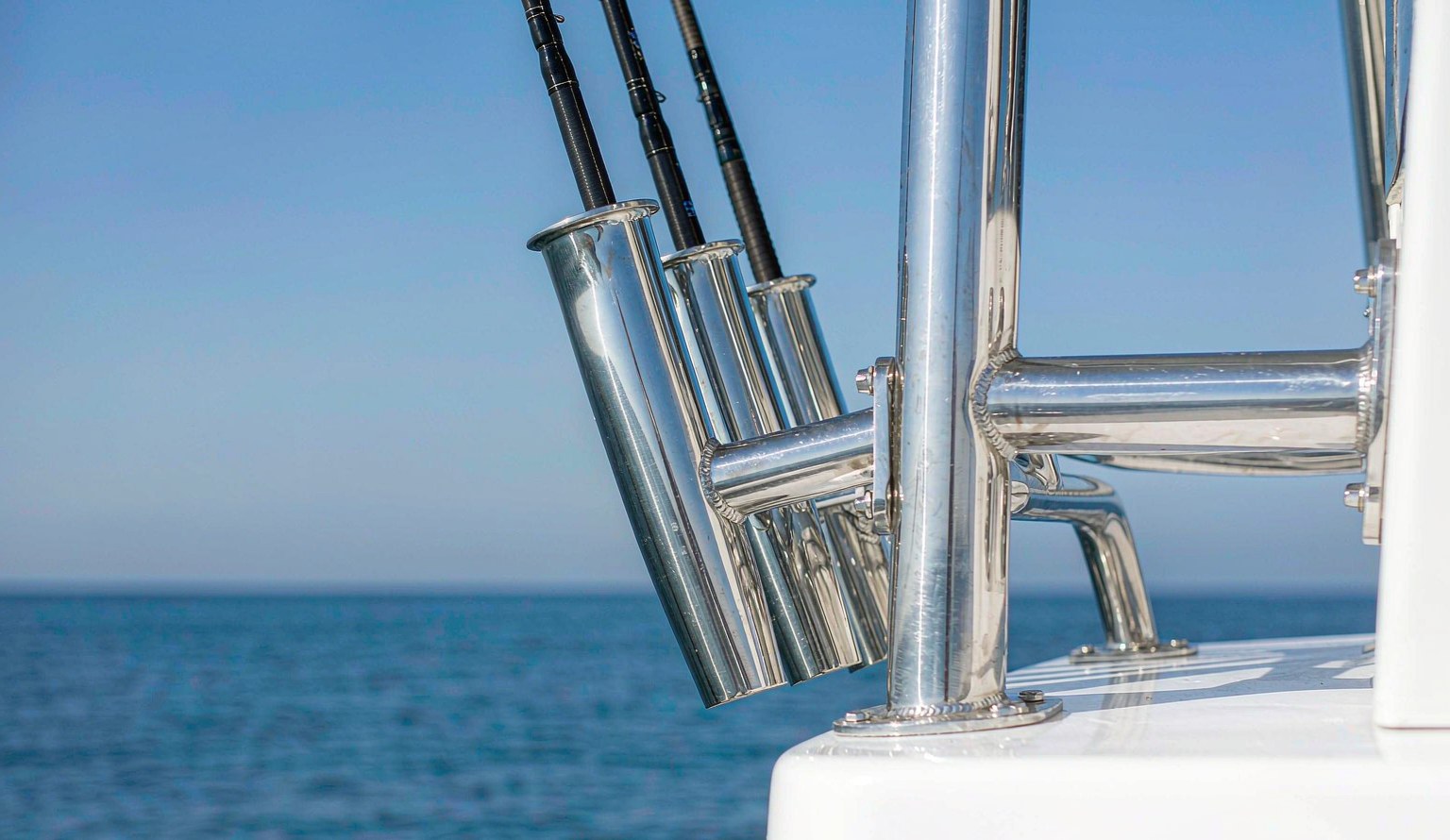
Every boater has seen it: a "stainless" cleat or rod holder streaked with orange rust pits after two seasons on the water. Almost every time, the culprit isn't bad luck — it's 304 steel sold as marine-grade. Here's how the two grades actually differ, and how to make sure you get what you pay for.
The one-sentence answer
316 contains 2–3% molybdenum; 304 doesn't. That single element is what lets 316 fight off chloride attack — the salt in saltwater — and it's the reason serious marine hardware is 316, full stop.
What the numbers mean
| Grade | Chromium | Nickel | Molybdenum | Verdict on a boat |
|---|---|---|---|---|
| 304 | 18–20% | 8–10.5% | none | Freshwater only; pits fast in salt |
| 316 | 16–18% | 10–14% | 2–3% | The saltwater standard |
Why molybdenum matters on the water
Saltwater is full of chloride ions, which attack the passive chromium-oxide layer that makes stainless "stainless." In 304, chlorides win locally: tiny pits form, oxygen can't reach the bottom of them, and corrosion accelerates inside the pit — classic orange staining around cleats, hinges and rod holder bases. The molybdenum in 316 hardens that passive layer against chloride, which is why 316 parts can sit in a salt-drenched cockpit for years and just need a rinse.
Crevice corrosion is the second killer: under a washer, a weld bead or a deck plate, oxygen-starved gaps turn aggressive. Again, 316 handles it far better — though no stainless is immune in a dead crevice.
Three tests that don't work (and one that does)
- The magnet test — useless. Both 304 and 316 are austenitic and mostly non-magnetic when annealed; cold working makes either grade slightly magnetic. Vendors pass off 304 as "non-magnetic 316" with this trick constantly.
- "It's stainless, trust me" — a sticker is not a certificate.
- Looks and polish — a mirror finish can hide the wrong alloy for a whole season.
- What works: paperwork and instruments. A batch spectrometer (PMI) report or Mill Test Report lists the actual chemistry of the heat of steel your parts came from. Reputable suppliers can produce one per order without drama.
The price question
316 typically carries a 10–25% premium over 304 in raw hardware. On a $40 cleat that's a few dollars; on a season of pitting, replacement labor and a corroded deck it's a bargain. The false economy isn't the part — it's the hole in the deck and the customer's trust.
Your pre-order checklist
- Ask specifically: "Is this 316, and can you include a batch material test report?"
- Confirm the grade is stated on the quote, not just in conversation.
- For critical load-bearing parts, ask for salt-spray test documentation.
- Beware prices 30%+ below market — 304 substitution is the most common way sellers hit those numbers.
At WOW's rod holder & railing line, every steel item is 316 marine-grade, and a batch spectrometer report ships with your order — so verification is paperwork, not faith. Request hardware with your spec sheet →
Where 304 is actually fine
This isn't a hit piece on 304 — it's a great alloy in the right seat. Interior fittings, freshwater-only boats, galley equipment and any hardware that lives under cover can run 304 for years without drama. The failure mode is specific: chlorides + time + oxygen starvation. A 304 drink holder on a lake pontoon is fine; the same part on a saltwater center console is a rust sticker waiting to happen. Match the grade to the water, not to the catalogue.
How 304 sneaks into the supply chain
Nobody in this industry sets out to buy 304 for a saltwater boat — it arrives by accident. The common routes: trading companies buying from whoever's cheapest that week without specifying heat numbers; mixed production runs where a factory makes both grades and the wrong batch gets polished and packed; and outright relabeling, where 304 parts are etched or boxed as "marine grade." This is why the asking matters less than the evidence: a genuine mill test report references a specific heat number you can trace, and a batch spectrometer report is generated from the actual parts in your order, not the brochures in the factory lobby.
What a real material report looks like
A credible batch report for your order should state: the steel grade (316 / 316L), the measured element percentages (Cr, Ni, Mo at minimum), the testing method (optical emission spectrometry or XRF), the batch or heat number, and the date. If a supplier sends a generic PDF with no batch reference, or refuses altogether, you've learned everything you need. At WOW, the spectrometer report ships with the order — it's a condition of sale, not a favor you have to beg for after wiring the deposit.
Frequently asked questions
Will 316 still rust?
Surface "tea staining" can appear in harsh, unwashed environments — it's cosmetic and rinses or polishes off. Structural pitting in service is rare when the part is genuinely 316 and periodically rinsed.
Is 304 acceptable for freshwater boats?
Generally yes for deck hardware on lakes and rivers. The risk is the boat that moves, or the trailer launched in brackish water — if there's any salt in the picture, 316 pays for itself.
What is 316L?
The low-carbon variant, used where heavy welding is involved because it resists weld-zone corrosion. For cast or machined deck hardware, standard 316 is normal.
Can I verify the grade myself after delivery?
Yes — handheld XRF analyzers read alloy composition in seconds. Marinas and inspection services offer it; or just rely on the batch report your supplier ships.