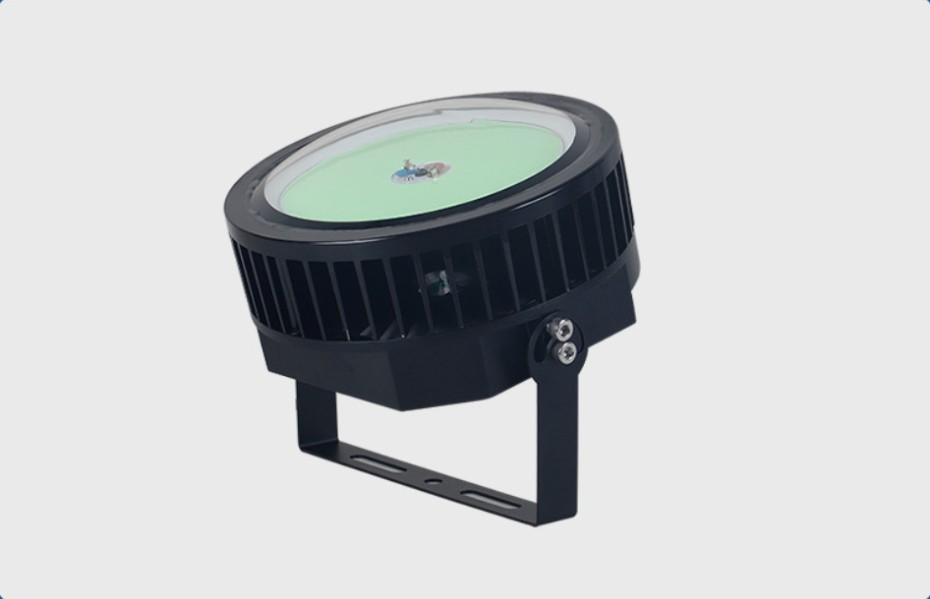
First, the category check most buyers skip: a boat-mounted fish-attracting light is not a submersible light. It never touches the water. It bolts to the rail, gunnel or boom above the waterline and throws a wide cone of light down onto the surface — the way commercial squid and sardine fleets have always lit their night sets. The housing is sealed against rain, spray and washdown, and the LED chips and driver are engineered for air cooling. Drop one over the side and you've bought yourself a very expensive paperweight. Now that we know what we're rigging, here's how to size it.
The quick answer
- 800 W: skiffs, dinghies and bay boats up to ~7 m — compact, forgiving on power, plenty for calm bays, estuaries and dock-adjacent sets.
- 1000 W: the offshore workhorse — one unit lays a swim-sized patch of light on the water from an 8–12 m boat. The industry's default for a reason.
- 1200 W: larger commercial hulls, murky water, or boats that must out-glow the neighbours — deepest penetration into the water column plus the widest surface halo.
How a boat-mounted light actually works
Submersible lights glow from below; these work from above. The beam (typically a 120° cone) strikes the surface and paints a bright disc on the water. That disc triggers the food chain from the bottom up: plankton gather in the light first, baitfish arrive on the plankton within minutes, and squid, sardines and game fish come for the baitfish. Crews call the result the halo — and the productive zone is the darker fringe around it, because fish feed at the shadow line, not dead-centre in the glare.
- Mounting height: 1.5–3 m above the waterline. Higher throws a wider, softer disc; lower punches a brighter, tighter one.
- Angle: tilt the cone down and slightly outward, off the leeward side, so the halo drifts with the current clear of the hull's shadow.
- Placement: surface-mount bracket on the rail, gunnel or a fixed boom. A rotating bracket (180°) lets you re-aim at each set instead of re-bolting.
- Timing: expect the first plankton and bait movement in 20–40 minutes. Switch on while positioning; net first, lines second.
Colour matters as much as watts
Fish respond to wavelength, not raw brightness. The working shorthand commercial crews use:
- Green — the all-rounder with the strongest phototaxis response: squid, sardine, shrimp, tilapia.
- White — general purpose; great lure-visibility for mackerel, snapper, sea bass.
- Blue — tuna, mackerel, trevally work.
- Red / yellow / cyan — species-specific tricks worth a conversation with your supplier.
This is why multi-colour units are taking over: one light, nine colours, matched to the night's target instead of buying three single-colour lamps. See the full colour-to-species chart on our RGB fishing light page →
The power math nobody shows you
A 1000 W unit on AC 220 V draws about 4.5 A (at power factor ~0.98) — modest for a genset, decisive if you were imagining an inverter. Before choosing wattage, know your real supply:
- Battery + inverter? Every conversion loses ~15% — a 1000 W light needs ~1,200 W of draw at the battery bank.
- Portable generator? 800–1200 W lights run happily on a 2 kVA set with headroom.
- Shore power / onboard AC? Any of the three wattages are plug-and-play.
Build quality checklist
- Housing: die-cast aluminium with a tempered-glass lens — not plastic that yellows after a season.
- Mounting: a rotating bracket (180°) lets you angle the cone into current instead of re-mounting.
- Weather proofing: look for rain/dust/rust-proof construction rated for salt spray.
- Lifespan: ~20,000 h LED life is the commercial benchmark — several seasons of full-night runs.
- Certification: ETL-certified models exist and matter for insured or charter operations.
WOW's RGB fishing lights run 800/1000/1200 W on AC 210–280 V with 9 switchable colours, from $190 — single-piece orders welcome. Tell us your boat and target species; we'll spec the wattage →
A worked example: 10 m centre console, squid night
Say you run a 10-metre centre console targeting squid two nights a week, with a 3 kVA generator and headroom to spare. One 1000 W unit in green, surface-mounted on the leeward rail bracket about 2 m above the waterline and tilted down-and-out, will paint a working halo on the water within 20–40 minutes in most conditions — bait first, squid ringing the fringe shortly after. Step up to 1200 W when you're fishing murkier water, a higher mount, or a night when neighbouring boats' lights are winning the plankton. Step down to 800 W if the same hull also does quiet river nights, where a blinding halo spooks more than it attracts. Same boat, three honest answers — which is why wattage is a range decision, not a scoreboard.
One big light or several small ones?
Two 800 W units spaced along the hull cast a wider, more even field than a single 1200 W dead-center — commercial squid boats spread lights along the rail for exactly this reason. But multiple units multiply wiring, mounting points and cost. The pragmatic rule: one light until you've learned your water, add a second on the opposite side only if fish keep holding just outside your halo.
Care, storage and the 20,000-hour promise
LED life ratings assume the housing can breathe and the lens can see. Rinse salt off after every run; check the cable grommet for nicks (the cable, not the lamp, is where most units die); and store the light dry rather than leaving it bracket-mounted through a monsoon season. Die-cast aluminium housings with tempered glass — like the RGB units in WOW's marine line — are built for exactly this routine; plastic-housed bargain units yellow and fog long before their chips expire.
Frequently asked questions
Is green really better than white?
For attracting baitfish and squid, green's 520–530 nm wavelength has the strongest documented phototaxis. White is more versatile for general game fish. If you only buy one colour, buy green; if you can, buy switchable.
Can I run an 800–1200 W light on 12 V?
Not directly — these AC models need 210–280 V. 12 V boats should look at the 100–400 W DC class instead.
Do these lights go underwater?
No. They're surface-mounted above the waterline and work by lighting the water from above. The IP65-class sealing is for rain, spray and washdown — submersible drop lights are a different product category entirely.
How high above the water should I mount it?
1.5–3 m is the working range. Lower mounts throw a brighter, tighter disc; higher mounts spread wider. Adjust tilt until the halo's fringe sits just past your chum line.
How long do they last?
Rated ~20,000 hours of LED life — hundreds of full nights. Salt crust on the lens is the only routine maintenance: rinse it.